The Corpus
Where a teacher assembles what counts as a source for a unit — textbook chapters, standards, primary documents, district policy. Nothing enters the corpus without being put there deliberately. Everything downstream cites back to it.
BlackBoard · a product of webspinner.com
We ask teachers to teach a technology that guesses. So we built them one that doesn’t.
BlackBoard is the Webspinner Foundation’s tooling for educators integrating AI into curriculum. It is grounded in sources the teacher chooses and can see. Free to educators and not-for-profit organisations, permanently.
The teacher’s problem
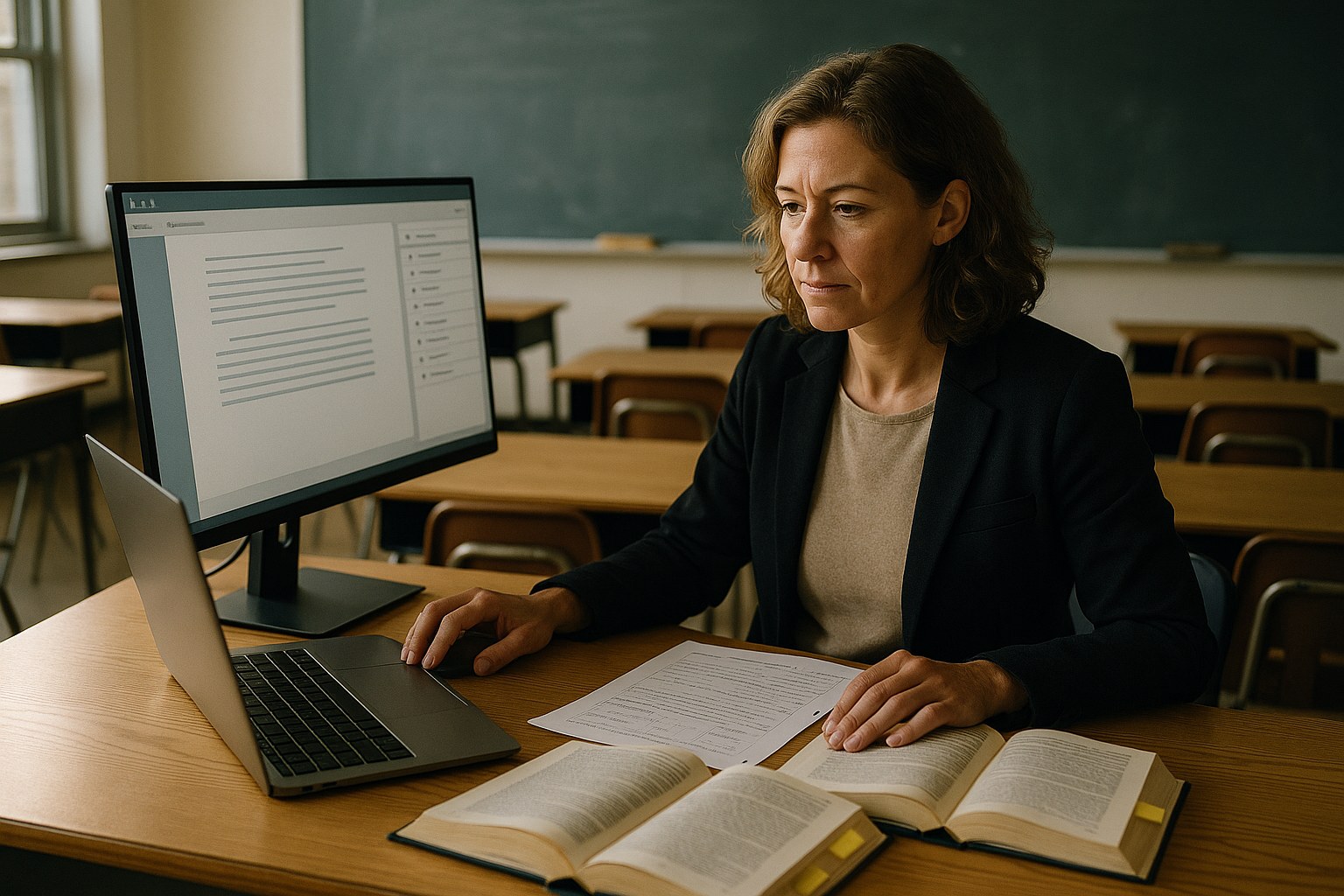
A teacher preparing a unit on AI is in an awkward position. The general-purpose assistant on her laptop will write her a lesson plan in nine seconds. It will also invent a citation, misstate a date, flatten a contested question into a confident summary, and give a different answer tomorrow — and none of that is visible on the page it produces.
She cannot put that in front of thirty children. Not because AI is dangerous in the abstract, but because she cannot show her working. A teacher’s authority rests on being able to say where a claim came from. A system that cannot answer that question is not a teaching tool, whatever else it is.
Teachers do not need an AI that is clever. They need one that is accountable.
The mechanism
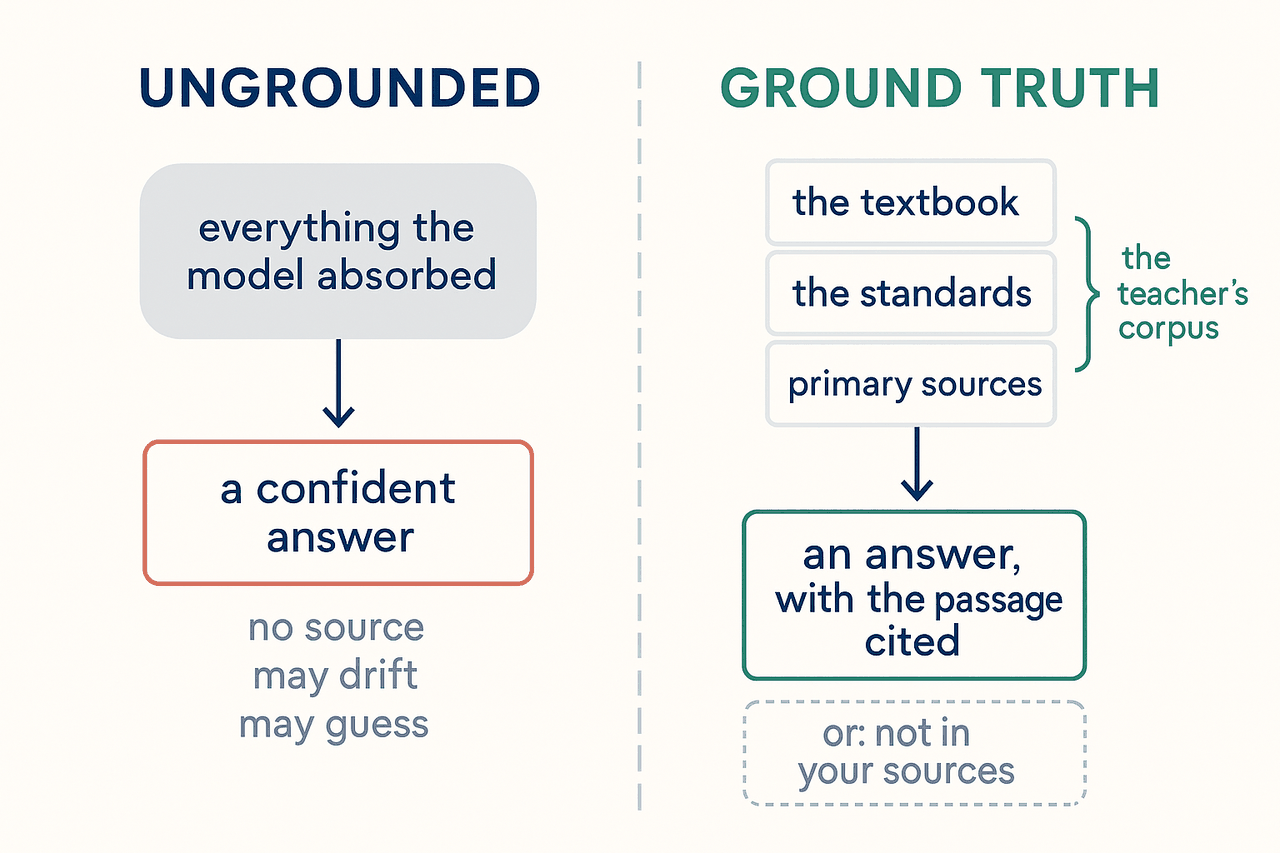
Ground Truth is the governing constraint underneath every BlackBoard tool. The principle is one sentence:
The system may only tell you things it can show you the source for.
A general assistant generates from everything it has ever absorbed, weighted by plausibility. A Ground Truth tool generates only from a corpus the teacher assembles and can inspect — the textbook, the standards document, the primary sources, the district policy, the reading list. Every sentence it returns carries a link back to the passage it came from. Ask it something outside that corpus and it does not improvise. It says it does not know, and tells you what it searched.
Our thesis holds that the evidence indicts unguarded, answer-dispensing AI — not AI as such. Bastani’s students lost 17% on unassisted exams with an unrestricted assistant, and recovered completely with one configured to give hints instead of answers. Ground Truth is that finding turned into infrastructure. It is the guardrail, built in at the tool layer rather than left to a teacher’s prompt discipline.
The idea underneath
A pathogen is a thing that spreads and causes harm. From the Greek pathos, suffering.
An agathogen is its opposite. From agathos, good: a thing built to spread, whose spreading does good.
A deepfake template passed between two boys becomes 350 images of 59 classmates. A manipulation technique that works once is copied a thousand times. Harm has always been good at spreading — that is what makes it harm rather than misfortune.
This is what our curriculum inoculates against.
A lesson that works in one classroom, written down so it works in ten thousand. A student framework drafted in a replica Senate chamber and sent to 10,000 school leaders. A verified source corpus, assembled once by one teacher, and then shared.
This is what BlackBoard is built to manufacture.
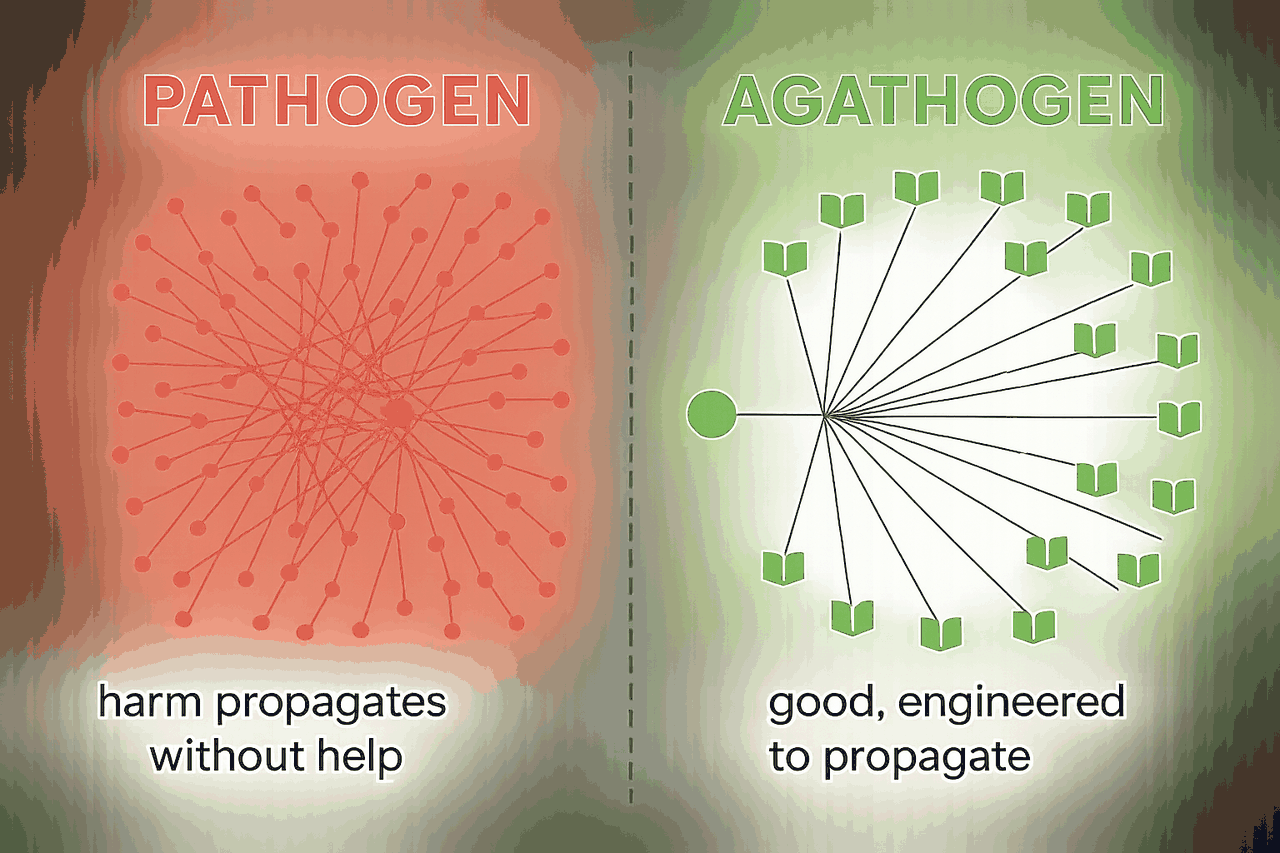
The insight is simply that good ideas do not spread by themselves. Harm has structural advantages: it is novel, it is urgent, it is emotionally sticky, and it needs no infrastructure to travel. A good idea — a well-built lesson, a careful framework, a verified set of sources — usually dies in the classroom where it was invented, because nobody built it a way out.
So we build the way out. Every artifact a teacher makes in BlackBoard is portable by construction: the corpus, the citations, the lesson, the assessment, packaged so another teacher can take it whole, see exactly what it rests on, and adapt it. That is the design goal, stated plainly — not to make one teacher faster, but to make one teacher’s good work contagious.
Hope is not a mood. It is a thing you can engineer for transmissibility.
The toolset
One name for the whole set of tooling. A product of webspinner.com, made free to educators and not-for-profit organisations. Every component obeys Ground Truth, and every component produces artifacts a colleague can pick up.
Where a teacher assembles what counts as a source for a unit — textbook chapters, standards, primary documents, district policy. Nothing enters the corpus without being put there deliberately. Everything downstream cites back to it.
Drafts against the corpus and only the corpus, with the source visible beside every claim. Aligns to the standards documents the teacher loaded, and shows which ones a lesson actually covers rather than asserting coverage.
Builds the pre/post instruments our curriculum requires, measuring transfer without the tool present. Because performance-with-access is not evidence of learning, and a tool that flatters its own usefulness is not measuring anything.
Human-in-the-loop production for teaching materials. ImageLab generates illustration with the previous frame always attached, so revisions refine rather than re-roll. VideoLab finds and licenses footage and prepares it for render. Nothing publishes without a person approving it.
The part that makes the rest matter. Any unit built in BlackBoard exports whole — corpus, citations, lessons, assessment, and the evidence of whether it worked — so another teacher can take it, inspect what it rests on, and adapt it for their own room. Openly licensed. No account required to receive one.
The commercial terms, in full
BlackBoard is free to educators and not-for-profit organisations. Not a trial, not a seat-limited tier, not free until the funding round closes.
Commercial licensing funds the free tier. That is the arrangement, and we would rather state it than have you wonder.

Where this is going
Every argument on this site comes back to the same person: an adult in a room, with thirty children, who is expected to teach a technology nobody has given her a trustworthy way to handle.
A moratorium does not help her. A general-purpose assistant that invents citations does not help her either. What helps is a tool that will only say what it can source, that behaves the same way tomorrow as it did today, and that turns the lesson she builds on a Tuesday evening into something a colleague three states away can use in September.
Inoculate the children. Arm the teachers. Make the good ideas spread faster than the bad ones.
Status: BlackBoard is in development. The studio components (ImageLab, VideoLab) are built and in use producing this site; the Corpus, Lesson Builder and Exchange are being designed with the pilot districts described on the About page. We will not claim a ship date we cannot keep.