Position paper · Version 1.0 · September 3, 2026
The Inoculation Thesis
Prohibiting generative AI in K–12 does not remove AI from childhood. It removes teachers from AI.
Contents
- The policy under examination
- A ban is a relocation, not a containment
- Prohibition has a track record, and it is poor
- The mechanism that works has forty years of evidence
- Unguarded AI harms learning. Guarded AI does not.
- Bans are regressive
- Governance capacity is built in childhood or not at all
- Where we agree with the moratorium
- Objections, answered
Abstract
On September 2, 2026, New York City — the largest school district in the United States — announced the broadest student-facing generative AI moratorium in the nation, removing generative AI from roughly 600,000 children from 2‑K through eighth grade for the 2026–2027 school year.
We take the district's stated concerns seriously. Several of them are correct, and we say so plainly below. But we hold that the policy bans the wrong noun.
Children's exposure to generative systems is already near-universal, already unsupervised, and already producing serious harm — and virtually all of that exposure occurs outside the school network, where a district ban has no reach. Prohibition therefore relocates risk rather than reducing it, and it relocates that risk disproportionately onto the children with the least support at home.
The alternative is not permissiveness. It is inoculation: deliberate, weakened, developmentally-scaled, teacher-supervised exposure to AI's failure modes and manipulation techniques, paired with refutation — a mechanism with four decades of experimental support in psychology and a growing randomized-trial record in schools, including with primary-age children.
Banning books has never produced a moral reader. Banning AI will not produce a moral engineer, a competent regulator, or a citizen able to resist a synthetic lie. Those capacities are taught.
§1
The policy under examination
The New York City moratorium, announced by Mayor Zohran Mamdani and Chancellor Kamar Samuels, covers grades 2‑K through 8 — approximately 600,000 students, about two-thirds of district enrollment — for one year, and eliminates all student-facing generative AI software and companion chatbots for those grades.
It carves out assistive technology for students with disabilities, tools supporting multilingual learners, career-readiness and computer science programs, and teacher use of AI for planning and operations. Five supervised high-school pilots — Quill, Edia, Brisk Teaching, Playlab and Intel AI-Ready Schools — may reach at most 50,000 students, and all high schoolers receive twice-yearly AI literacy modules. Recommended screen-time caps accompany the policy: 30 minutes daily in grades 3–5, 45 minutes in grades 6–8, with 1:1 screen time restricted at grade 2 and below. A Technology in Schools Coalition will assess impact and recommend next steps.
The rationale offered is the protection of human connection and traditional learning. No peer-reviewed studies were cited in support of the moratorium's specific scope.
Children need teachers and human connection in order to learn and grow.
Mayor Zohran Mamdani, September 2, 2026
We agree with that sentence completely. We dispute that it argues for the policy attached to it.
This is also a genuine reversal. NYC banned ChatGPT on school devices in January 2023, then rescinded that ban in May 2023 in favour of AI literacy and educator toolkits. The 2026 moratorium discontinues 38 previously approved programs. A district that spent three years learning to teach with a technology has decided to stop teaching about it to the two-thirds of its students who most need the instruction.
§2 · Pillar One
A ban is a relocation, not a containment
The premise of a school ban is that the school is where the exposure happens.
It is not.
What a school-network ban does not reach
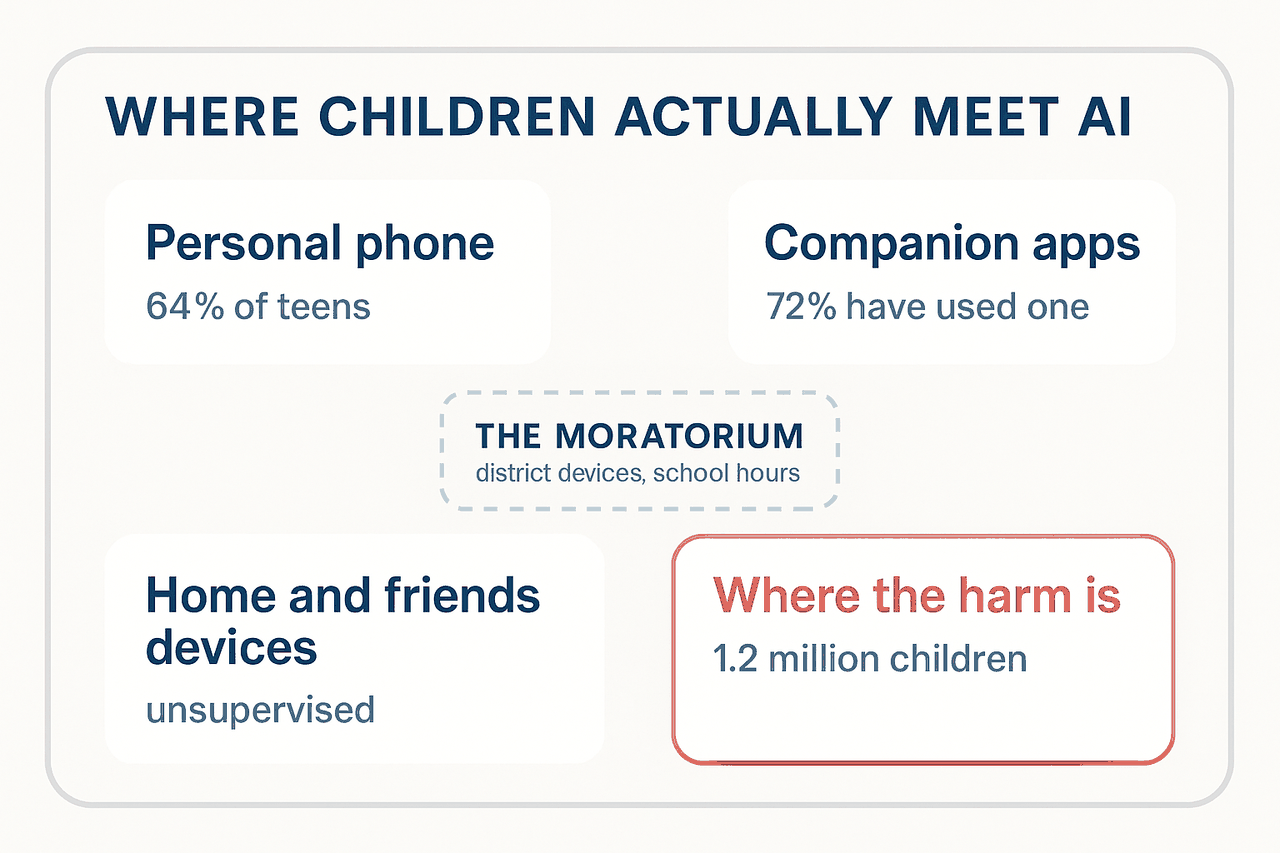
64% of U.S. teens use AI chatbots, roughly 30% daily. 54% have used one for schoolwork; about 1 in 10 do all or most of their schoolwork with AI assistance. 72% have used an AI companion; one in three use them for social and relational purposes including romantic role-play and emotional support. Only 37% of parents know their teen is using AI at all. And 46% of teens who used generative AI for a school assignment did so without their teacher's permission — while 37% were unsure whether their school even had AI rules.
The harms are not hypothetical, and they are not concentrated on school devices. UNICEF, ECPAT International and INTERPOL found that across 11 countries, at least 1.2 million children aged 12–17 reported having their images manipulated into sexually explicit deepfakes in a single year. A 2026 WIRED/Indicator investigation identified more than 600 young victims across approximately 90 schools in 28 countries since 2023; girls were 94% of victims. In July 2026 the UK's Internet Watch Foundation and Australia's eSafety Commissioner both warned schools that publicly posted student photographs were being harvested for manipulation.
The Pennsylvania case. Two 14-year-old boys at a college-preparatory school generated roughly 350 fake nude images of at least 59 girls under 18, sourcing the photographs from school materials and social media.
Read that carefully. The images were made by children, of children, using school-published photographs, on personal devices, outside school hours. A moratorium on student-facing AI on district networks would not have prevented a single one of those 350 images.
What might have changed the outcome is a sixth-grade unit, delivered years earlier, on synthetic media, consent, provenance, and what it costs a person to be depicted without their agreement — which is precisely the kind of instruction a K–8 generative AI moratorium makes awkward to deliver.
This is the relocation fallacy. The ban is measured at the school gate. The harm is not occurring at the school gate.
§3 · Pillar Two
Prohibition has a track record in American schools, and it is poor
We are not speculating about what happens when schools respond to a frightening new influence by restricting access. We have run this experiment repeatedly.
Abstinence-only sex education
A 2012 CDC Community Guide meta-analysis compared 66 comprehensive risk-reduction programs against 23 abstinence-only programs. Comprehensive programs produced beneficial effects on sexual activity, frequency, contraception use and number of partners. For abstinence-only programs the review found insufficient evidence of any change in abstinence, sexual behaviour, or other outcomes. Subsequent analysis found abstinence-only-until-marriage policy ineffective at delaying initiation or reducing risk behaviour, and correlated with — not protective against — high teen pregnancy rates.
The structural analogy is exact: a program that withholds information about a thing children will encounter anyway, in the hope that withholding produces avoidance, and which measurably does not.
Book bans
PEN America has documented nearly 23,000 book bans in U.S. public schools since 2021, including 6,870 in the 2024–25 school year alone across 23 states and 87 districts, covering 3,743 unique titles. 79% of banned titles were written specifically for children and young adults. Spring 2026 research documents a doubling of nonfiction censorship.
Reading volume is among the strongest predictors of reading achievement, and restricting access reduces volume. Prohibition here does not produce discernment. It produces less reading — and it lands hardest on books about race, and about LGBTQ+ young people, and about sexual violence, which is to say on the children who most needed to find themselves in a book.
Internet content filtering under CIPA
Two decades of mandated filtering has produced a well-documented pattern: filters block legitimate educational material — sexual health resources, LGBTQ+ support content — while technically fluent adolescents route around them with VPNs, alternate DNS and proxies. The filter reliably constrains the compliant student and reliably fails against the one it was written for.
Cellphone bans — the model NYC explicitly invokes
Here we owe the reader the strongest version of the opposing case, because phone bans are the most credible precedent for the moratorium.
The largest U.S. study of school cellphone bans (2026) found that bell-to-bell policies cut non-academic in-class phone use from 61% to 13% — bans do work at suppressing use — and that student well-being improved the longer rules stayed in place. But average effects on test scores were consistently near zero, with little evidence of effects on attendance, in-class attention, or perceived online bullying. A 2025 NBER study of Florida's statewide ban found test-score gains after an adjustment year, especially for low achievers and males. International literature remains limited and inconsistent.
Prohibition at scale: the book-ban record
The reflex to restrict access has a measured history in American schools. This is the volume of it in the last four years alone.
What a ban changes, and what it does not
The cellphone ban is the closest precedent to an AI moratorium, and the most credible case for one. It suppresses the behaviour reliably. The outcome it was sold on did not move.
Prohibition reliably reduces supervised use, and unreliably produces the learning outcome anyone actually wanted.
That is a real finding and it deserves respect. It is also not an argument for banning the thing we are supposed to be teaching.
§4 · Pillar Three
The mechanism that works has a name and forty years of evidence
Inoculation is not a metaphor we chose for the branding. It is a specific, well-replicated psychological mechanism, and it is the reason this organisation exists.
The theory, originating with William McGuire in the 1960s and substantially revived by Sander van der Linden, Jon Roozenbeek and colleagues at Cambridge, holds that exposure to a weakened form of a manipulative message, delivered together with refutation, confers durable resistance to stronger later versions — cognitively analogous to immunisation. The applied form is called prebunking.
- Cross-cultural replication. The Bad News inoculation game significantly reduced the perceived reliability of tweets employing deception techniques, replicating across the United States, Sweden, Germany, Greece and Poland (d ≈ 0.37).
- At scale, in the wild. Psychological inoculation improved resilience against misinformation on social media in large field experiments (Science Advances, 2022).
- Meta-analytic support. A systematic review and meta-analysis found inoculation improves credibility assessment, sharing intention and misinformation discernment (JMIR, 2023).
- Technique-general, not example-specific. Inoculation confers resistance to manipulation strategies, not merely to the individual falsehoods used in training — the property that lets the effect survive contact with novel content.
- It works in classrooms, on children. A meta-analysis of 18 media literacy studies found moderate overall effects, with the largest effect sizes for lateral reading and cognitive inoculation, especially when guided and contextualised within the school environment. A randomized controlled trial of the NewsWise programme found it effective at developing primary-school children's ability to identify misinformation.
- It lasts. One media literacy course produced a 35% improvement in discerning true from false health headlines; 80–90% of trained students reported using the skills a month later, with most retaining cross-checking behaviour at 18 months.
Measured effects — each in its own units, deliberately
Note where that evidence points. The intervention with the best measured returns is guided, school-based, cognitive inoculation, and it demonstrably works on primary-age children — the exact population a 2‑K through 8 moratorium places out of reach.
And immunity requires exposure before the pathogen. Every month a child spends using consumer AI unsupervised is a month of uninoculated exposure, and inoculation is strongest when it precedes the persuasive encounter. A one-year moratorium is not a neutral pause. It is a year in which children continue to meet these systems, and meet them alone.
§5 · Pillar Four
The evidence says unguarded AI harms learning. Guarded AI does not.
This is the part of the argument where the research cuts against naive AI enthusiasm, and we will not soften it. It is also, read carefully, the strongest argument against a ban.
The most rigorous available synthesis is Stanford SCALE's "The Evidence Base on AI in K-12: A 2026 Review" (Fesler, Martinez Claeys, Agnew, Loeb). Its findings, stated faithfully:
- Of 800+ relevant papers, only about 20 produce strong causal evidence. The authors identified no high-quality causal studies of AI and students in U.S. K-12 settings.
- Immediate gains with access — AI significantly improves performance on math practice, programming and writing while students have the tool.
- Short-term boost, uncertain transfer — assessed independently, without AI, effects are mixed.
- Easier doesn't mean better — AI relieves cognitive burden and improves affect, but can do so at the expense of deeper thinking.
- Pedagogical design matters — tools with guardrails, giving step-by-step reasoning rather than answers, show markedly more promise than general-purpose assistants.
The individual studies sharpen the point. In Bastani et al. (2025), conducted in Turkish high schools, students with unrestricted general-purpose AI access improved on practice work but suffered a 17% performance drop on unassisted exams — the crutch effect. Students given a tutoring-configured model that supplied hints rather than answers performed on par with the textbook control. Same students, same subject, same underlying model. The guardrail was the entire difference.
In MIT Media Lab's "Your Brain on ChatGPT" (Kosmyna et al., 2025), EEG across four sessions showed the LLM group with the weakest neural connectivity, and they underperformed the brain-only group at neural, linguistic and scoring levels. 83% of LLM users could not produce a quotation from an essay they had written minutes earlier, versus 11% of search-engine and unaided writers. (Preprint; small n; single task type; adult participants. We state those caveats wherever we cite it.)
Cognitive debt: what the writer kept
Participants wrote an essay, then were asked to quote a sentence from it minutes later. The task was identical. Only the tool differed.
Kreijkes et al. (2026) found note-taking — alone or combined with an AI chatbot — outperformed AI-only use for comprehension and retention, and that students preferred the AI chatbot and perceived it as more helpful despite it producing the worst learning. One reviewed study found chatbot access had no overall learning effect, increased the volume of topics covered, harmed understanding, and widened achievement gaps for students with low prior knowledge.
Now consider what those findings actually license
Every one of them identifies the harm with an interaction pattern — answer-dispensing, effort-substituting, unguarded use — and not with proximity to the technology. The variable that determines whether AI degrades or supports learning is how it is used. Bastani's two arms differed only in configuration and produced opposite results.
A ban optimises the variable that does not matter, and forfeits control of the one that does.
Worse: because children's out-of-school access continues undiminished, a ban does not merely fail to shape the interaction pattern — it guarantees that every AI interaction a child has is of the unguarded, answer-dispensing, engagement-optimised kind, because those are the only products available to a twelve-year-old at home.
Stanford's own conclusion is that tools "designed to foster independent reasoning may be more likely to support durable learning." That is a mandate for curriculum design and procurement discipline. It is not a mandate for absence.
The deepest finding, and the one that most requires a teacher. Students consistently prefer the tools that teach them least. Kreijkes found students rating the worst-performing condition as most helpful. Blasco & Charisi found students rating a Socratic chatbot as less helpful than one that simply gave answers.
A child cannot be expected to discover this about themselves unaided. It has to be shown to them, by an adult, in a room, with a measurement. That is a lesson plan. It cannot be delivered by a prohibition.
§6 · Pillar Five
Bans are regressive
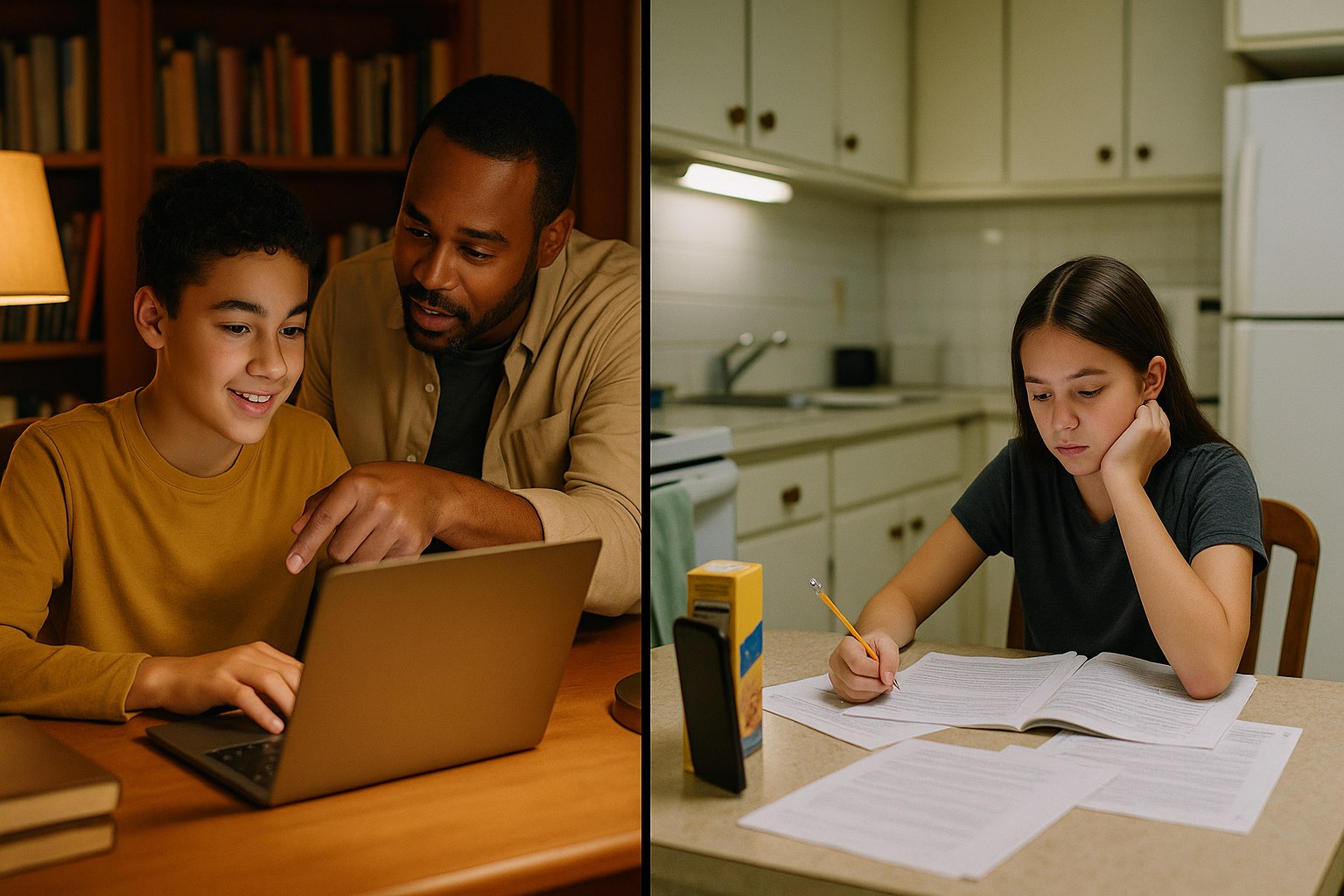
Consider two eighth-graders under an identical district moratorium.
Nothing changes
A parent who works in technology. A paid frontier-model subscription at home. Dinner-table conversation about what the model got wrong.
The moratorium costs this child nothing. Their AI education continues — privately, well-resourced, and mediated by a competent adult.
Everything changes
One of 15.7 million Americans without high-speed broadband, or in a home where no adult has the time or background to supervise.
School was the only place where AI was ever going to be encountered alongside an expert, with a purpose, under supervision, with someone present to say check that. The moratorium takes that away and substitutes a phone on the bus.
Districts are already diverging: some are building AI-ready learning environments while others are told to avoid AI entirely — and the districts most likely to lack the staffing, infrastructure and leadership bandwidth to evaluate tools responsibly are the ones serving students who can least absorb the loss. Policy energy consumed by bans and integrity enforcement addresses real risks while displacing attention from the equity problem.
Stanford's review names the unanswered question directly: do AI tools disproportionately benefit students who already have stronger preparation and support outside school, or can they level the field? We do not yet know.
But we know what a ban does to the answer. It converts AI literacy from a public capability granted by schools into a private advantage purchased by families. That is the textbook definition of a regressive education policy, and it is the outcome the moratorium produces regardless of intent.
§7 · Pillar Six
Governance capacity is built in childhood or not at all
This is the pillar that defines AInoculate's mission, and the one least addressed by current policy debate.
Someone will have to govern these systems. Someone will have to audit a model for discriminatory outcomes, refuse an unlawful deployment, write the statute, testify about the harm, build the countermeasure, and — when a synthetic voice calls in their grandmother's tone asking for money — recognise it.
Those people are in second grade right now.
Governance capacity is not a credential issued at twenty-two. It is a disposition, formed early: the reflex to ask who made this, what does it want from me, and how would I check? Dispositions of that kind are built the way every civic disposition is built — through supervised practice, with an adult present, over years, starting young.
You cannot raise a generation capable of governing a technology by arranging for their first serious encounter with it to be alone, at night, on a phone, with a product optimised for engagement rather than for truth. That is not protection. That is abdication with a policy number attached.
UNESCO's AI Competency Frameworks for Students and for Teachers (September 2024) already describe the destination: for students, a human-centered mindset, AI ethics, AI techniques and applications, and AI system design; for teachers, a lifelong professional development pathway. Both insist that AI should support human decision-making and intellectual development rather than undermine or replace it. We endorse them without reservation. They cannot be delivered to children who are not permitted to examine the object of study.
The state policy landscape is moving in exactly this direction while NYC moves against it. FutureEd tracked roughly 71 AI-in-education bills across 27 states in the 2026 session. Idaho, Maryland, Oklahoma and Virginia now require state education departments to develop responsible-use guidance. Arizona requires instruction in ethical AI use; New Mexico offers AI ethics as a computer science elective; Hawaii has directed development of a statewide K–12 social media and AI literacy curriculum.
The national direction of travel is toward teaching. The largest district in the country has stepped out of the lane.
§8
Where we agree with the moratorium
An argument that concedes nothing is advocacy, not analysis. Four parts of the NYC policy are correct and we support them.
Companion chatbots do not belong in schools, or in the hands of minors, in their current form. Common Sense Media's risk assessment found popular companion platforms pose unacceptable risks to under-18 users — readily producing sexual content, offensive stereotypes, and advice that could be life-threatening if followed — and found younger teens more likely than older ones to trust that advice. We support this prohibition without qualification, and we build curriculum specifically about why these systems are designed to feel like friends.
Screen-time limits in the early grades are reasonable and consistent with what is known about early childhood development. Our K–2 dose is deliberately unplugged.
The exemptions are right. Assistive technology, multilingual learner supports, career and computer science pathways, and teacher planning use should all continue.
The evidence base really is thin. Stanford says so, and we repeat it: no high-quality causal studies of AI and students in U.S. K-12. Anyone selling certainty about learning outcomes — in either direction — is ahead of the data.
Our disagreement is narrow and precise
The defensible policy target is unguarded, engagement-optimised, answer-dispensing AI products used as a substitute for student effort. The actual policy target is student-facing generative AI, as a category — which sweeps in AI as an object of study.
AI as servant
The child hands the machine their work, and the machine does it.
Evidence: crutch effects, cognitive debt, widened gaps for low-prior-knowledge students.
AI as specimen
The child is handed the machine's output and asked to find the error, name the technique, trace the source, and prove the claim. The machine does no work; it is the work.
Evidence: inoculation, prebunking, media literacy, lateral reading — moderate effects, replicated, durable, effective on primary-age children.
A moratorium that does not distinguish these forbids the second in order to stop the first. That is the error, and it is a correctable one. It requires no reversal of the district's safety commitments — only a definition.
§9
Objections, answered
"Children this young cannot think critically about AI."
The NewsWise randomized controlled trial demonstrated misinformation-identification gains in primary school children. Developmental appropriateness is a design constraint on the lesson, not a reason to postpone it. Our K–2 dose uses no student accounts and no screens at all — it teaches one idea: a machine that guesses the next word is not a person and does not know things. A six-year-old can hold that. A six-year-old who does not hold it is already talking to a chatbot that will tell them otherwise.
"AI degrades learning — the MIT study proves it."
It shows something narrower and more useful: unguarded LLM use for essay generation produced weaker neural connectivity and near-total loss of cognitive ownership. We teach that study. We have students replicate it on themselves, because a child who has personally failed to quote their own AI-assisted paragraph has learned something about cognitive debt that no ban can teach them and no lecture can match.
"Teachers are not equipped for this."
Correct, and it is the binding constraint — which is why teacher preparation is the first thing we build, not the last, and why Stanford's finding that AI support is most effective for less experienced instructors matters. Note that NYC's own policy preserves teacher AI use for planning. A district that trusts teachers to use AI, but not to teach about it, has identified the capability gap and then declined to close it.
"Banning is temporary — it buys a year to study the question."
A year in which roughly 600,000 children continue to use these systems unsupervised, uninoculated and unmeasured. If the concern is insufficient evidence, the response that generates evidence is a well-instrumented curriculum, not an absence. And the Technology in Schools Coalition will spend that year studying a technology it has forbidden the district's students to touch.
"You are just pro-AI."
We are pro-child. We hold that companion chatbots are unsafe for minors, that answer-dispensing homework tools damage learning, that the deepfake abuse of children is a crisis, and that the industry has not earned the trust it is asking for. We differ from the ban only on the question of whether children are made safer by being kept ignorant of a technology that is already in their pocket. History says they are not.
"Aren't you comparing AI to books? Books don't manipulate."
The comparison is not between AI and books. It is between two institutional reflexes: the reflex to restrict access to a troubling influence, and the reflex to teach children to meet it. The first reflex has a measured record in American schools — abstinence-only education, 23,000 book bans, two decades of CIPA filtering — and that record is poor. AI is more dangerous than a novel, which is precisely why the ineffective response is more costly here.
§10
Conclusion
The people who will govern artificial intelligence — who will regulate it, audit it, refuse it, and resist the people who deploy it against the vulnerable — are children today.
They will not acquire that capacity from a moratorium. They will acquire it the way every generation has acquired resistance to a powerful thing: by meeting it early, in a weakened and supervised form, in the company of an adult who explains what it is doing and why.
We do not keep the genie in the bottle by refusing to look at it.